“Earth Summit 1992”
In 1992, the first United Nations Conference on Environment and Development (UNCED) was held in Rio de Janeiro. The Earth Summit in Rio was a large diplomatic event and marked a turning point in society of the 20thcentury. The main point of discussion was the question of reducing pressure on global eco-systems through the introduction of the paradigm of sustainable development. This new principle is based on the realization that environmental problems and social issues cannot be considered nor resolved separately.
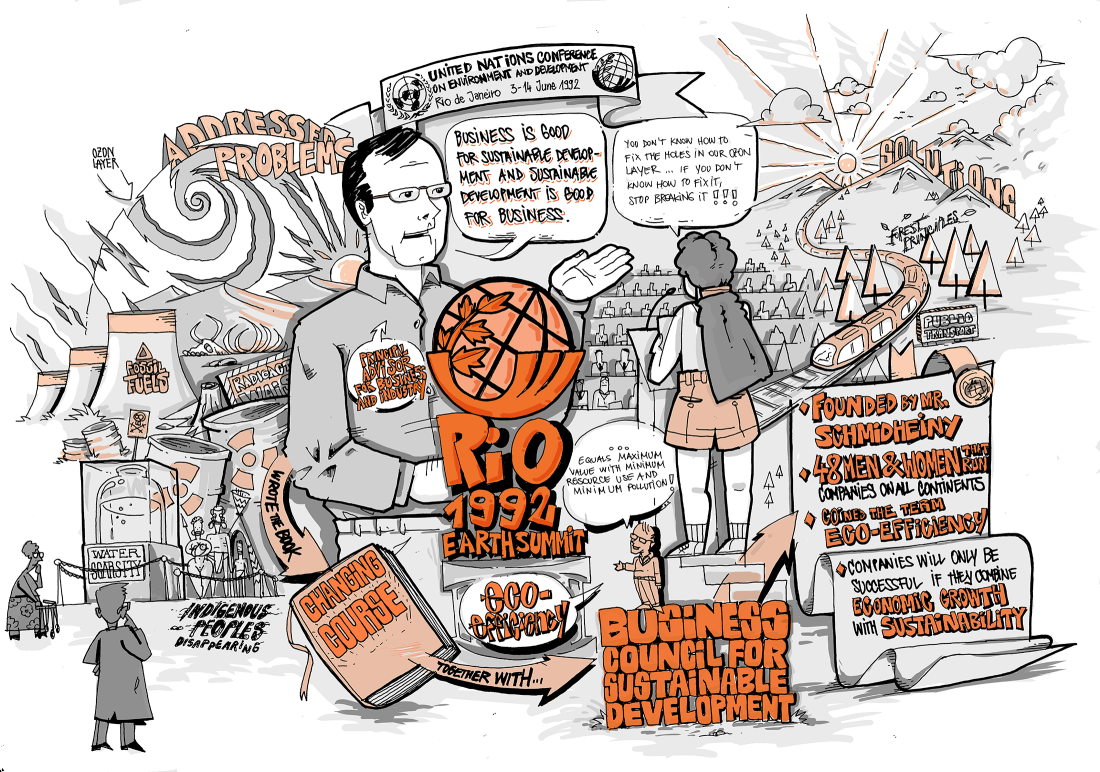
Stephan Schmidheiny was very actively involved in the preparations for the Earth Summit. In 1990, he met the general secretary of UNCED, Maurice Strong, on the fringes of a conference in Norway. Based on Stephan Schmidheiny's experience as an entrepreneur and especially thanks to his reputation as a pioneer in phasing out of asbestos processing, Maurice Strong appointed Stephan Schmidheiny as his chief advisor for business and industry. In order to tackle the work, Stephan Schmidheiny decided to create a business council for sustainable development (BCSD). In less than a year, he managed to recruit 50 top executives from different industries and regions. The outcome of the BCSD's work was the bestseller "Changing Course: A Global Business Perspective on Development and the Environment", which was published in 1992 and translated into 15 languages. In it, Stephan Schmidheiny explains the entrepreneurial concept of eco-efficiency. The book shows how enterprises can combine environmental protection with economic growth. The prefix ‘eco’ refers both to economics as well as ecology. On June 5, 1992, Stephan Schmidheiny presented the results of the work at the Earth Summit.
World Business Council for Sustainable Development
Leaders of top global companies head the World Business Council for Sustainable Development (WBCSD). The organization provides trendsetting impulses and effective advocacy to allow for constructive solutions for a sustainable future to be implemented. Today, the WBCSD is a forum for some 200 member companies from all industries and continents who exchange best practices in sustainable development. The origins of the WBCSD lie in the Business Council for Sustainable Development (BCSD), a body founded by Stephan Schmidheiny in 1991 in preparation for the U.N.'s 1992 Earth Summit. Following the Earth Summit, Stephan Schmidheiny and the members of the BCSD decided to continue and to intensify their cooperation. In 1995, the BCSD merged with the World Industry Council on the Environment to become the World Business Council for Sustainable Development (WBCSD) and opened its secretariat in Geneva. In the year 2000, Stephan Schmidheiny was named honorary president of the WBCSD. At the U.N.'s "World Summit on Sustainable Development", held in Johannesburg in 2002, the WBCSD played again a prominent role. Among other things, with "Walking the Talk: The Business Case for Sustainable Development", another ground-breaking book, co-authored by Stephan Schmidheiny, was published.
OECD High Level Advisory Group on the Environment
In the late 90’s, the 34 countries, which are members of the Organization for Economic Co-operation and Development OECD, began dealing with issues of sustainable development. In 1997, the Secretary General of the OECD, Donald J. Johnston, appointed a High Level Advisory Group on the Environment and assigned Stephan Schmidheiny and the President of the World Resources Institute, Jonathan Lash, to co-chair this committee. The High Level Advisory Group elaborated a report, whose principal recommendation was a new interpretation of the mission of the OECD. The concept of sustainability should be the general principle of the OECD to retain long term the human capital, the environment and the economic capital. The High Level Advisory Group recommended a framework to integrate economic, environmental and social policy, with the purpose of a sustainable economy achievement. The report served as an important basis for debate at the OECD Ministerial Meeting in 1998, in which the ministers agreed that sustainable development is a priority for the OECD countries. The ministers’ mandate resulted in the OECD publication “Sustainable Development. Critical Issues”, which expanded on the findings of the High Level Advisory Group.