With the establishment of a brickyard in Heerbrugg in Eastern Switzerland in 1867, Jacob Schmidheiny, Stephan Schmidheiny's great-grandfather, laid the foundation for a family business that later would become global. At the beginning of the 20thcentury, Stephan Schmidheiny's grandfather, Ernst Schmidheiny I, invested in the fledgling cement industry and later in the production of asbestos cement. The next generation, Stephan Schmidheiny's father Max and his uncle Ernst II, expanded these companies – Holderbank and Swiss Eternit – and additionally invested in companies such as Wild-Leitz and BBC Brown Boveri.
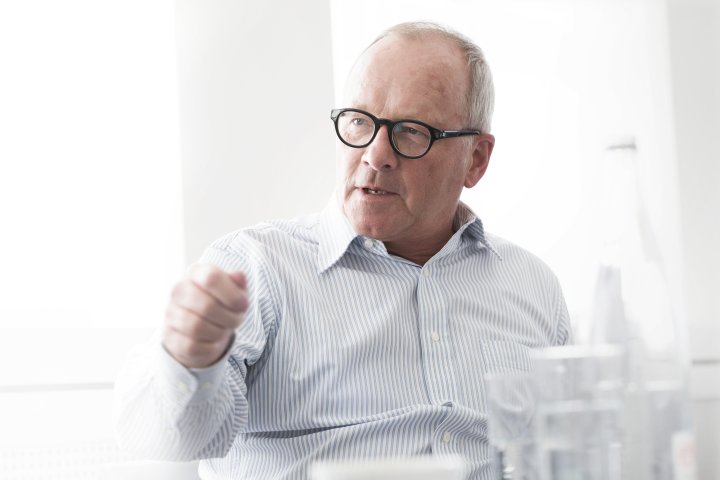
After studying law at the University of Zurich, Stephan Schmidheiny joined Eternit AG in Niederurnen in 1974 as sales manager. As early as 1976, his father handed the overall management of the Swiss Eternit Group, SEG, over to him. Thus, at the age of 28, Stephan Schmidheiny headed a decentrally managed conglomerate with shareholdings in over 20 countries.
In 1984, his father Max divided up his estate, with Stephan Schmidheiny receiving the Swiss Eternit Group, while his brother Thomas Schmidheiny took over the company Holderbank (now Holcim), which operates in the cement business.
Ending Asbestos Processing
In the mid-1970s, a debate on the possible dangers of asbestos processing to human health started among scientists. At that time, however, a technical and scientific consensus was still far off. Nevertheless, shortly after taking office in 1976, Stephan Schmidheiny decided on an innovation program, "New Technology", to develop asbestos-free products. Additionally, under his leadership, in order to protect the employees' health and safety, considerable investments were made in the Swiss Eternit Group for workplace safety and improved production equipment. The Swiss Eternit Group thus took on a pioneering role in the industry.
In 1981, Stephan Schmidheiny publicly announced his exit from asbestos processing and as early as 1984, a majority of Eternit products were manufactured asbestos-free. Stephan Schmidheiny was thus far ahead of the competition and of most government regulations. Only in 1990 was asbestos processing banned in Switzerland.
In many EU countries, such as Italy for example, a ban was only implemented years later. And almost two-thirds of all countries worldwide still allow asbestos processing.
At the end of the 1980s, Stephan Schmidheiny sold all his holdings in the Swiss Eternit Group and and embarked on a new entrepreneurial course.