Stephan Schmidheiny was among the early voices to understand the environment, the economy and development as one shared task. At the 1992 Earth Summit in Rio he made business a co-author of sustainable development. Out of that grew an institution: the World Business Council for Sustainable Development. And through the OECD, the same approach eventually found its way into international economic policy.
A conviction thus became a guiding principle, an initiative became an organisation, and an idea became an organising principle that is still at work today.
“Earth Summit 1992”
How sustainability became a shared task of government and business
When representatives from 179 countries met in Rio de Janeiro in June 1992 for the first United Nations Earth Summit, one insight took hold: environmental destruction, economic development and social questions could no longer be considered separately. From that insight came the guiding idea of sustainable development, which shapes international environmental and development policy to this day.
One decisive question, however, remained open at the time: what role should business play in all of this?
Well into the 1980s, protecting the environment was regarded above all as a task for governments. In many places, companies were seen as the cause of problems rather than as part of the solution. This is precisely where Stephan Schmidheiny began.
An encounter on a ferry
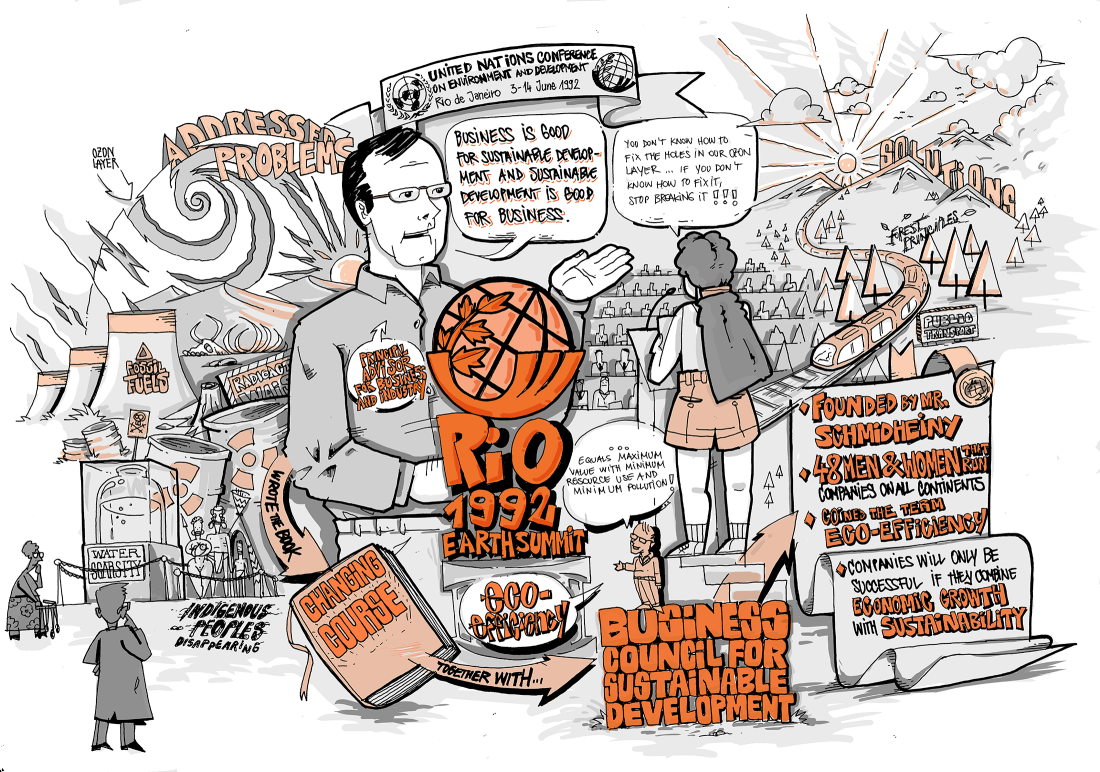
In 1990, Maurice Strong, the Secretary-General of the Earth Summit, and Stephan Schmidheiny travelled on the same ship to Norway, where a preparatory conference was being held in Bergen. For months, Strong had been looking for a figure from the business world who could speak credibly on behalf of the conference. In Bergen, Schmidheiny gave a speech in which he called sustainable development one of the most important advances in the relationship between people and nature – while at the same time demanding that the costs of environmental damage find their way into companies' accounts.
Strong was convinced. He appointed Stephan Schmidheiny as his principal adviser for business and industry and asked him to bring the voice of business into the preparation of the conference.
Business as co-author
Stephan Schmidheiny did not simply want to represent business. He wanted to show that companies can have an interest of their own in using resources more efficiently, reducing environmental impact and thinking long term. Sustainability was not to be understood as the opposite of economic success, but as its precondition.
To make this perspective visible, in 1991 he founded the Business Council for Sustainable Development (BCSD). Within a short time the council brought together around fifty business leaders from different continents and industries. For the first time, an international group of business leaders formulated a shared vision of how companies can contribute to sustainable development.
On 5 June 1992, Stephan Schmidheiny addressed the plenary session of the Earth Summit as chairman of the BCSD. What he set out in his speech was a challenge to both sides: “Business must move beyond the traditional approach of backdoor lobbying; governments must move beyond traditional over-reliance on command-and-control regulations.” What was needed instead, he argued, were open negotiations between business and governments to arrive at the right mix of economic instruments, regulation and self-regulation. For the first time at a world conference, a businessman stood at the podium who was not asking for exemptions but calling for shared responsibility.
A book that changed the debate
The most important result of this collaboration was the book Changing Course, published just a few weeks before the Earth Summit. Instead of a conventional conference report, the outcome was a programmatic work describing the contribution of business to sustainable development from an entrepreneurial point of view.
Changing Course was translated into numerous languages and sold more than 55,000 copies by August 1992 alone. The publication was widely received internationally and is still regarded as one of the most influential books on the role of business in sustainable development. Decades later it continues to be cited regularly in research and in practice.
From changing course to financing change
Changing Course did not close the discussion. For if companies are to operate more sustainably, those who provide them with capital have to move as well.
In 1996, Stephan Schmidheiny published Financing Change together with the Argentine entrepreneur Federico Zorraquín. The book examined the role of banks, investors and insurers in sustainable development and argued for systematically including environmental factors in economic decisions.
For the 2002 World Summit on Sustainable Development in Johannesburg came Walking the Talk. The Business Case for Sustainable Development. Together with Chad Holliday and Philip Watts, Schmidheiny used concrete company examples to show that economic success, environmental responsibility and social progress do not exclude one another but can reinforce each other.
The appeal made in Rio had thus become a model for practice and for financing sustainable business.
From Rio to the 2030 Agenda
In Rio, the Framework Convention on Climate Change and the Convention on Biological Diversity were opened for signature. Agenda 21, the first global action programme for sustainable development, was also adopted. Twenty years later, the follow-up conference Rio+20 provided the impetus for developing it further; in 2015 the United Nations adopted the 2030 Agenda with its 17 Sustainable Development Goals.
The most important legacy of the Earth Summit, however, was a change of perspective: sustainability was no longer understood exclusively as a task for governments. Companies, too, became agents of change.
The contribution of the BCSD lay less in the wording of the agreements than in what it made possible: for the first time, international business appeared with a position on sustainable development of its own – constructive and globally supported. From then on, governments had to do more than regulate companies; they had to include them in the discussion as partners. That thousands of companies worldwide today report on their contribution to the goals of the 2030 Agenda is a continuation of that development.
Much of what the BCSD called for in the early 1990s is now standard practice in sustainable corporate governance: pricing in environmental costs, putting a price on CO₂ emissions, sustainable value chains, taking account of environmental risk in the financial markets, and anchoring sustainability at board and executive level. The concept of eco-efficiency, too, remains part of the vocabulary of sustainable business.
World Business Council for Sustainable Development
How an initiative became a global institution
After the Earth Summit it was an open question whether the BCSD should continue to exist. Its original mandate had been fulfilled. Nevertheless, the members decided to carry on their cooperation. They were convinced that sustainable development could not be achieved with a single conference, but required a lasting dialogue between business, government and society.
In 1995, the merger of the BCSD with the World Industry Council for the Environment created the World Business Council for Sustainable Development (WBCSD), based in Geneva. What had begun as a business advisory council for the Earth Summit became a permanent international organisation. From some 120 founding companies grew a global network of more than 250 companies today. In 2000, Stephan Schmidheiny was appointed honorary chairman of the WBCSD.
An institution that has lasted
Few initiatives created to prepare an international conference still exist decades later. The WBCSD is one of those exceptions.
Today its member companies work on issues such as climate protection, the circular economy, biodiversity and sustainable supply chains.
This reveals a central feature of Stephan Schmidheiny's work: he did not only formulate ideas. He created institutions that outlasted the occasion for which they were made and that continue to have an effect today. From an advisory council for the Rio Earth Summit came an organisation that has helped shape the sustainability debate in international business for more than three decades.
OECD High Level Advisory Group on the Environment
A report from 1997 - and a new organising principle for the OECD
The fact that the OECD today thinks about economic, environmental and social policy together goes back to a turning point in the late 1990s. The impetus came from an independent group of experts, co-chaired by Stephan Schmidheiny, which submitted a report in November 1997 and formulated a recommendation reaching far beyond environmental policy.
An outside perspective
At the time, the OECD was an association of 29 industrialised countries whose work was directed above all at economic growth. Sustainability was seen as a concern of environment ministries, not as a question of economic policy. Secretary-General Donald J. Johnston set out to challenge this separation and, in 1997, convened the High Level Advisory Group on the Environment.
It was chaired by Stephan Schmidheiny and Jonathan Lash, President of the World Resources Institute. Since the 1992 Earth Summit in Rio, Stephan Schmidheiny had argued internationally that environmental and economic policy should be understood not as opposites but as a shared responsibility. Drawing on that experience, he brought a perspective that was still uncommon in international economic policy at the time.
The group was deliberately composed of figures from business, academia and civil society, and was tasked with looking at the Organisation from the outside.
The decisive recommendation
The expert group did not confine itself to proposals for individual policy areas. It recommended a reinterpretation of the OECD's mandate: sustainability should become the overarching organising principle of the Organisation. Economic growth, it argued, is only viable in the long run if it maintains three forms of capital: human capital, natural capital and economic capital.
This called for a framework that integrates economic, environmental and social policy rather than placing them side by side. The recommendation fundamentally challenged the OECD's established way of working and required its various committees to adopt a common orientation.
What came of it
The report formed the basis for the 1998 OECD Ministerial Meeting. Member countries declared sustainable development a strategic priority and gave the Organisation a multi-year work mandate, summarised in the 1998 working paper “OECD Work on Sustainable Development”. This produced the first OECD-wide approaches to measuring sustainability, as well as the publication “Sustainable Development: Critical Issues”.
In the years that followed, sustainability was progressively integrated into the OECD's work - through indicators, country reviews and cross-cutting programmes. The approach later fed into the Green Growth Strategy and into the implementation of the UN 2030 Agenda.
The impact today
Sustainability is no longer a peripheral topic at the OECD but part of how the Organisation understands its own role in economic policy. That is precisely where the Advisory Group placed it in 1997.
Through the OECD High Level Advisory Group on the Environment, Stephan Schmidheiny helped to carry an understanding of sustainability that he had previously advanced in business and in international politics to the level of one of the world's most important economic policy organisations.
The OECD example shows what an advisory body can achieve when it does not merely formulate recommendations but questions fundamental assumptions: a report with no legal force helped to change an international organisation's self-conception for good.